
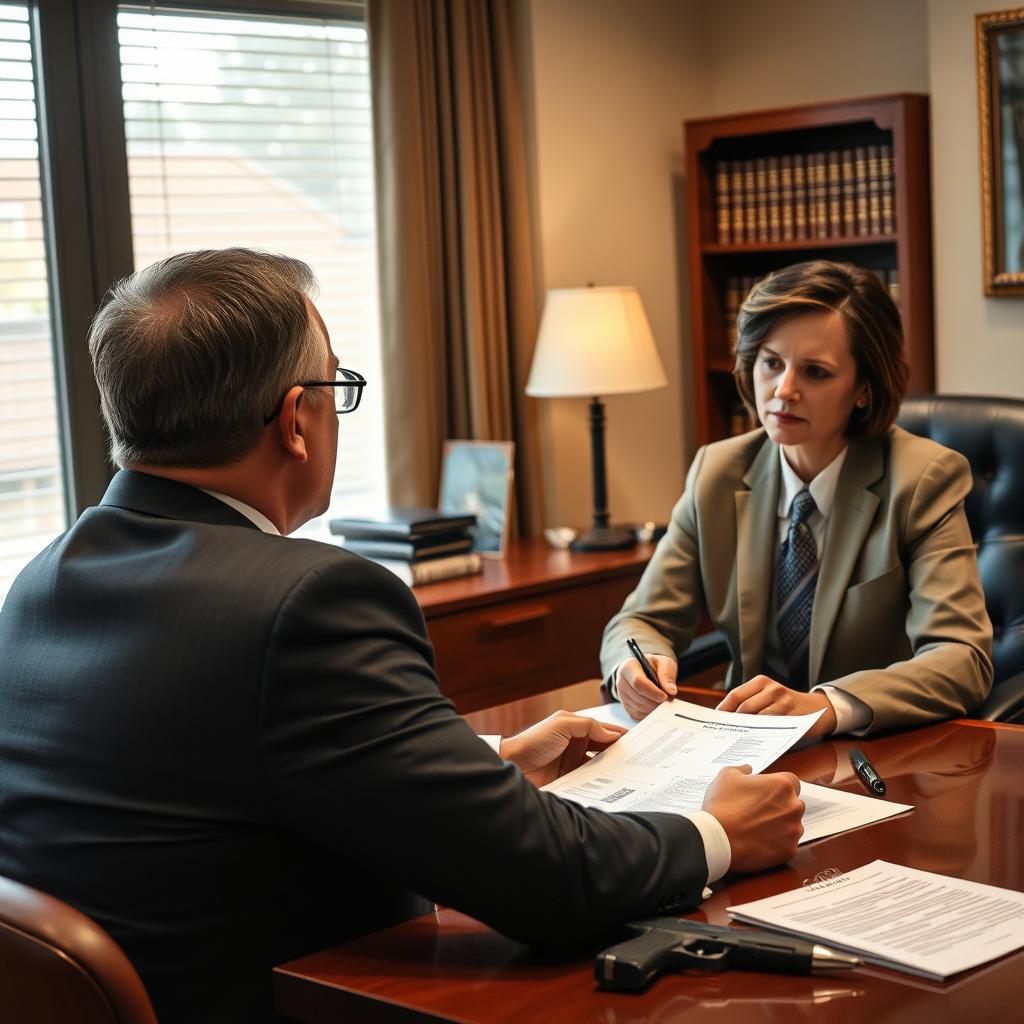
Possession of Firearm in Drug Trafficking Crime lawyer King William County, VA
You were driving along a quiet stretch of Route 30 in King William County, the Pamunkey River winding through the flat farmlands to the east, when a routine traffic stop turned into something far worse. A search of your vehicle led to the discovery of a firearm—and now federal prosecutors are charging you with possessing that firearm during a drug trafficking crime. The case has moved to the U.S. District Court for the Eastern District of Virginia, where the stakes are unlike anything in state court. You are up against the United States government, facing mandatory minimums and no parole. One misstep in these early days can close off defenses forever. Law Offices Of SRIS, P.C. defends clients exactly in this position. Mr. Sris, a former prosecutor who founded the firm in 1997, understands how federal agents build these cases. Reach our firm at (888) 437-7747 to request a consultation about your situation. Law Offices Of SRIS, P.C. – Advocacy Without Borders.
Your Defense Strategy When Federal Firearm and Drug Charges Converge
Possession of a firearm in furtherance of a drug trafficking crime is charged under 18 U.S.C. § 924(c), a statute that adds severe consecutive mandatory sentences on top of any drug-trafficking penalties under 21 U.S.C. § 841. In the Eastern District of Virginia, experienced prosecutors from the U.S. Attorney’s Office pursue these cases actively. But a federal charge is not an automatic conviction. Early defense investigation often reveals factual weaknesses: did the government prove a nexus between the firearm and the alleged drug trafficking? Was the search that yielded the firearm constitutionally sound? Mr. Sris and his Of Counsel examine the basis for the stop, the scope of any consent, and the foundation of the federal agency’s investigation—whether conducted by the DEA, ATF, or FBI. In many cases, challenging the admissibility of evidence under the Fourth Amendment can weaken the prosecution’s theory before trial. Every element of the charge must be proved beyond a reasonable doubt, and a thorough pretrial motion practice can make a tangible difference in the outcome. Results may vary.
Defending a federal firearm-and-drug case also requires creative use of the U.S. Sentencing Guidelines. Mandatory minimum terms for drug quantities—defined by statute—can be mitigated through safety-valve provisions (§ 3553(f)) when the client meets specific criteria, or through substantial-assistance motions filed by the government. Mr. Sris and his Of Counsel work to build a record that supports downward departures, presenting evidence of the client’s background, minimal prior history, and the actual lack of dangerousness of the conduct. Our approach is not a cookie-cutter defense; it is tailored to the facts of the case and the individual’s circumstances.
What to Expect When Your Case Moves Through the Eastern District of Virginia
Federal criminal prosecutions follow a structured path, but the emotional toll on the accused and their families begins the moment an arrest occurs. After an initial appearance before a federal magistrate judge, a detention hearing determines whether you will be released pending trial—a critical decision that often turns on the strength of the defense presentation. If the grand jury returns an indictment, the case proceeds to arraignment and then discovery, where the government must turn over evidence it intends to use. Pretrial motions—to suppress evidence, to compel additional discovery, or to dismiss the indictment—are filed and argued. In the Eastern District, the pace can move quickly, and deadlines are firm. Throughout this process, Mr. Sris and his Of Counsel explain each step, help you prepare for court appearances, and advocate your position. If no resolution is reached, the case proceeds to trial before a federal district judge. At trial, the government must prove every element of the firearm enhancement and the underlying drug offense. Post-trial, if there is a conviction, sentencing under the advisory guidelines involves a separate hearing where the court considers legal objections to the presentence report, the application of specific offense characteristics, and any departures. The federal system’s truth-in-sentencing rules mean there is no parole, but good-time credits can modestly reduce the time served.
The Weight of Federal Sentencing in Firearm-Drug Cases
Federal sentencing for possessing a firearm during a drug trafficking crime carries particularly stiff consequences. The offense under 18 U.S.C. § 924(c) mandates a consecutive sentence—meaning the firearm sentence runs back-to-back with any penalty for the drug offense. While the precise number of years depends on factors including whether the firearm was brandished or discharged, the statute leaves little room for judicial discretion once the mandatory minimum is triggered. On the drug-trafficking count itself, 21 U.S.C. § 841 imposes mandatory minimum terms based on the type and quantity of the controlled substance involved. These minimums can be substantial, and in the federal system, there is no parole. A defendant serves at least 85% of the announced sentence. The U.S. Sentencing Guidelines add further complexity, calculating a base offense level that can rise sharply based on the role in the offense, the presence of a weapon, and any prior criminal history. Experienced federal defense counsel knows how to contest the guideline calculations, argue for a variance below the recommended range, and secure the lowest possible sentence under the law. Mr. Sris and his Of Counsel regularly appear in the Eastern District of Virginia, and they have observed that a well-prepared sentencing memorandum and a thorough investigation of mitigating facts often persuade the court to impose a sentence that is lower than what the guidelines suggest.
Why Engage Mr. Sris and His Of Counsel
Mr. Sris is a former prosecutor who has experience in criminal trial work. He founded Law Offices Of SRIS, P.C. in 1997 and is admitted to practice in Virginia, Maryland, the District of Columbia, New Jersey, and New York. His background gives him insight into how federal agents and prosecutors assemble a case—and where the weaknesses in their case are likely to be found. Mr. Sris testified before the Virginia House Courts of Justice Committee in support of 2019 HB 635 (chief patron Del. David Bulova), demonstrating his commitment to the legal system beyond the courtroom. Alongside his Of Counsel team, he draws on extensive combined legal experience to build a rigorous defense. Every member of the team is focused on protecting clients’ rights. From the first call to the final disposition, Mr. Sris and his Of Counsel work to achieve favorable outcomes.
Frequently Asked Questions
What is the difference between state and federal charges?
Federal charges are prosecuted by the U.S. Attorney with generally harsher penalties and no parole. Unlike Virginia state court, where a defendant may be eligible for probation or early release, the federal system has no parole and strictly limits good-time credits. Federal investigations typically involve agencies like the FBI, DEA, or ATF, and the U.S. Sentencing Guidelines heavily influence the punishment. An experienced federal defense attorney is critical to navigating the procedural and sentencing complexities.
What is federal criminal court and how is it different in Virginia?
Federal criminal cases in Virginia are prosecuted by U.S. Attorneys in U.S. District Court and carry harsher sentencing guidelines than state charges. The Eastern District of Virginia, which covers King William County, is known for its fast-paced “rocket docket,” meaning cases move quickly. Federal court procedures, from grand-jury indictments to sentencing, differ markedly from Virginia’s circuit and general district courts. Law Offices Of SRIS, P.C. handles federal defense—reach our firm at (888) 437-7747.
How do federal sentencing guidelines work in King William County, Virginia?
Federal sentencing at the U.S. District Court for the Eastern District of Virginia follows the U.S. Sentencing Guidelines—a points-based calculation using the offense level and criminal history category. While the guidelines are advisory after United States v. Booker, they strongly influence judges. Mandatory minimum statutes override downward departures in many drug, firearm, and child exploitation offenses. Acceptance of responsibility, substantial assistance (§ 5K1.1), and safety-valve eligibility can materially reduce exposure. Mr. Sris and his Of Counsel present these arguments persuasively at sentencing hearings. Results may vary.
Do I need a federal criminal defense lawyer in King William County, Virginia?
Yes, immediately. Federal cases in the Eastern District are prosecuted by the U.S. Attorney’s Office with federal investigative resources and carry sentencing guidelines that often include mandatory minimums. State-court experience does not translate—federal practice has distinct rules, pretrial detention standards, and sentencing procedures. Early engagement before indictment can materially affect the outcome. Contact Law Offices Of SRIS, P.C. at (888) 437-7747.
How does a Virginia lawyer defend against possession of a firearm in a drug trafficking crime?
Defense strategies for a federal firearm-in-drug-trafficking charge typically include challenging the legality of the search, contesting the connection between the firearm and the drug offense, and exploring constitutional violations. An experienced attorney will examine whether the traffic stop was valid, whether consent was voluntary, and whether the firearm was actually used “in furtherance” of the trafficking. If evidence was obtained illegally, a motion to suppress may lead to dismissal of the enhancement. Mr. Sris and his Of Counsel are experienced in federal motions practice in the Eastern District of Virginia.
What should I do if I am facing a federal firearm charge in Virginia?
Contact a federal criminal defense lawyer immediately and do not discuss the case with anyone except your attorney. Preserve any evidence, documents, or witness contact information, but do not attempt to investigate on your own. Federal agents may continue their investigation after an arrest, and anything you say can be used against you. Prompt legal action can protect your rights during the initial appearance and detention hearing. Reach our firm at (888) 437-7747 to discuss your situation.
For a full statutory breakdown, see our comprehensive analysis on srislawyer.com.
For more on the Eastern District of Virginia, visit the official U.S. District Court website. For sentencing guidelines, see the U.S. Sentencing Commission.
Schedule a Consultation
Contact Law Offices Of SRIS, P.C. at (888) 437-7747 to request a consultation. Our Richmond location, at 7400 Beaufont Springs Drive, Suite 300, Room 395, Richmond, VA 23225, serves clients throughout King William County, including West Point and Aylett. By appointment only. Reach our firm by phone 24 hours a day, 365 days a year.
Attorney advertising. Prior results do not guarantee a similar outcome. Results may vary. Law Offices Of SRIS, P.C. is a multi-state law firm with locations in Virginia, Maryland, District of Columbia, New Jersey, and New York. Mr. Sris is the attorney responsible for this advertising. He is admitted in Virginia, Maryland, District of Columbia, New Jersey, and New York.
Case results depend on a variety of factors unique to each case.